

In the food industry, microbiology laboratories rely on increasingly sophisticated and sensitive detection and enumeration methods.
What is the actual influence of sample grinding on the accuracy of analyses ?
To answer this question, we entrusted ESIAB (Ecole Supérieure d’Ingénieurs en Agroalimentaire de Bretagne atlantique) with a rigorous comparative study. The objective is to evaluate the effectiveness of two types of grinders on the same sensitive food sample.
Why is the grinder crucial in preparing food samples ?
Grinding is a key step in the preparation of food samples. It is essential to ensure reliable results.
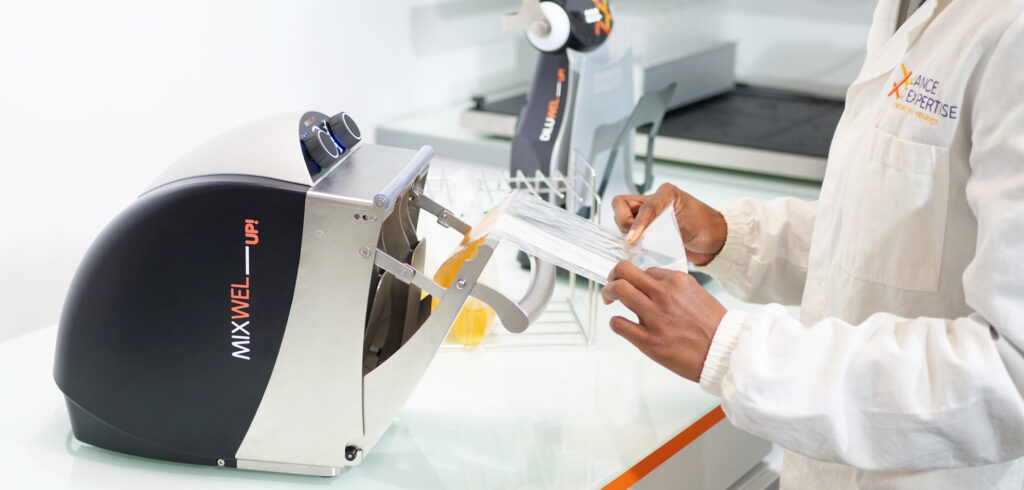
Homogenization and extraction of microorganisms
Good homogenization ensures better recovery of the microorganisms present in the mass. Grinding the matrix structure mixes and releases trapped bacteria to ensure more accurate and reproducible assay results while reducing the risk of biased sampling.
Ensure safety and health compliance
In order to ensure consumer safety, regulatory and quality control protocols impose a certain rigor during microbiological analysis.
In particular, ISO 7218 (General requirements and guidance for microbiological examination) and ISO 6887-1 (Preparation of samples, parent suspension and decimal dilutions for microbiological examination) describe the use of laboratory grinders during the analytical process of a food sample.
The semi-automated device adheres to these requirements and ensures health compliance.
Boost efficiency and prevent MSDs
Utilizing a high-performance automatic grinder dramatically decreases the physical exertion needed to break down intricate food structures while also minimizing operational time.
By optimizing the ergonomics of laboratory workstations, this equipment prevents the appearance of bad postures and significantly reduces the occurrence of musculoskeletal disorders among technicians.
Agri-food environment: experimental protocol for extraction
To gauge the precision of the outcomes, a thorough procedure was conducted as part of a test on a intricate matrix. Cocktail sausages whose particularly “slippery” skin complicates the homogenization process were used.
1. Inoculation of a calibrated E. coli strain
To ensure the repeatability of the test, a controlled contamination was carried out on a sausage sample. A specific Escherichia coli strain calibrated precisely at 7,400 CFU was inoculated directly into its core.
2. Blending samples according to the two distinct technologies
The products thus prepared were subjected to a comparative mixing. The two laboratory blender mill technologies were used in parallel to objectively measure the extraction efficiency of each mechanical system.
3. Comparative Analysis on TBX Agar
After the preparation phase, the suspensions obtained were seeded on a selective culture medium. Here, on TBX agar. This step allows the counting and comparative analysis of the bacterial concentrations collected after incubation.
Comparison of the two types of microbiological homogenizers
On the market, several grinding technologies exist. But what are their respective performances in terms of microbiological extraction ?
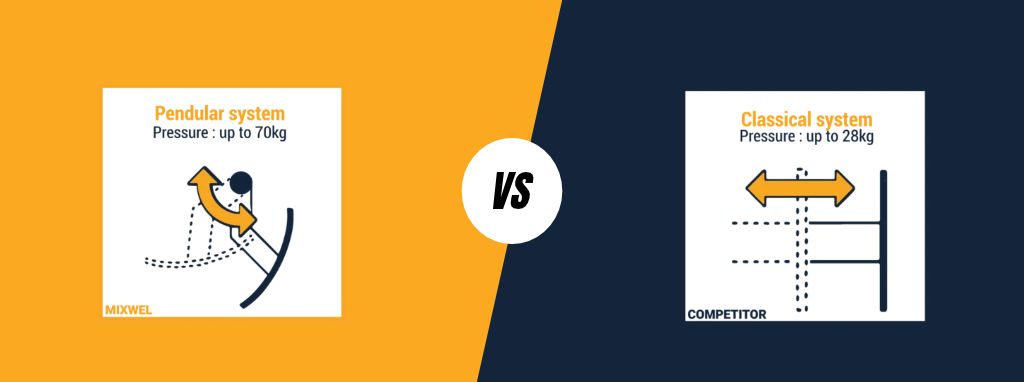
This test contrasts the flat pressure of traditional systems with the patented pendulum-motion pressure technology of the MIXWEL UP!
The oscillation pressure from the MIXWEL UP!
As for him, he uses a unique patented pendular blade system thus applying a maximum pressure delivering up to 70kg per blade.
The flat pressure of conventional systems
Blenders with a conventional system operate mainly by flat pressing, from left to right. This system exerts pressure up to 28 kg.
Study Results : MIXWEL UP vs. classical blenders
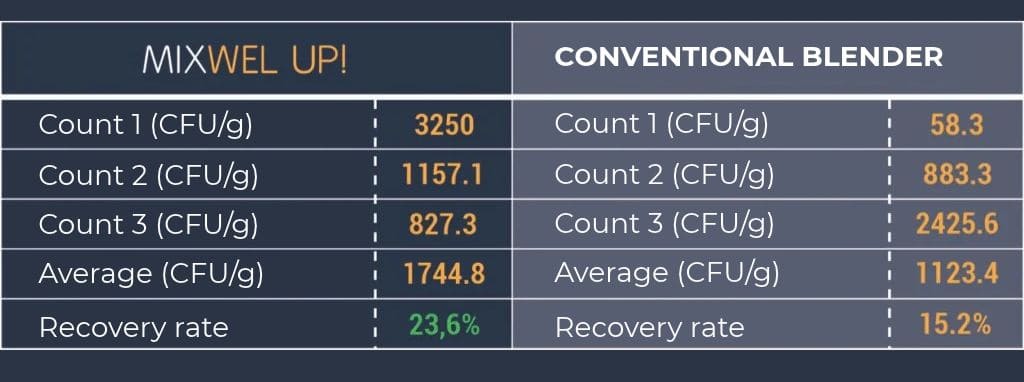
The MIXWEL UP! pendular system offers a recovery rate 50% higher than that of a conventional grinding !
Comparative bacterial counts
The results confirm that the pendular technology of the MIXWEL UP! grinder offers a higher extraction capacity than the conventional blender.
Indeed, the post-blending concentration obtained is approximately 1,5 times higher with the MIXWEL UP! yielding an average count of 1744.8 CFU/g compared to 1123.4 CFU/g for the traditional blender.
The MIXWEL UP! system allows for a significantly larger amount of bacterial flora to be collected from an identical initial load.
Recovery rates evaluation
One of the key indicators proving the efficiency of extraction is the recovery rate.
We can see here that the recovery rate of Escherichia coli is reached with MIXWEL UP! is 23.6% compared to only 15.2% with the conventional flat-pressure blender.
This difference is explained by a better distributed mechanical action thanks to the pendulum movement of the blades.
Optimized blending for reliable extraction
This study highlights the impact of the choice of blender in sample preparation. Effective blending ensures better recovery of microorganisms and therefore a more reliable and representative analysis.
Thanks to its innovative pendular system, the MIXWEL UP! ensures optimal extraction, ensuring better homogenization of food matrices and more accurate results.
Opt for the MIXWEL UP! , it is to reduce the variability of enumerations, ensure tests repeatability and eliminate risks of misinterpretation during the microbiological controls.
Ready to optimize your sample preparation ?
👉 Want to learn more about MIXWEL UP! or test it in your lab ?
Contact us now by filling out this form below :
"*" indicates required fields
